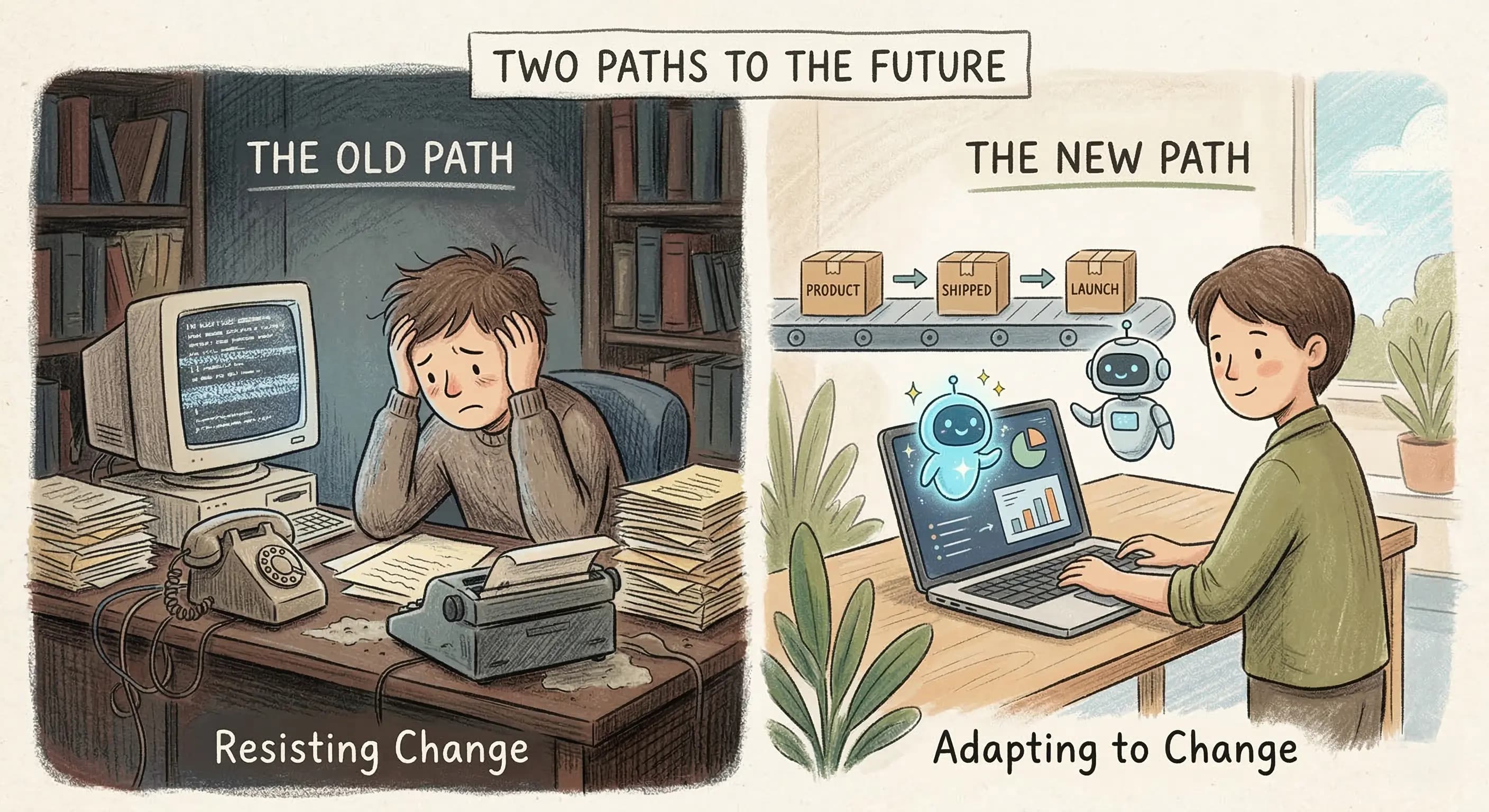
In February 2026, payments company Block laid off about 40% of its staff, cutting over 4,000 employees. The reason wasn't a bad quarter or a failed product. CEO Jack Dorsey said AI tools had changed what it means to build and run a company, and the business simply didn't need as many people anymore [CITE: CNN Business, February 2026]. Block's stock surged more than 15% the following day.
That's not a warning about the future. That already happened.
But here's the part most people get wrong about the "will AI replace your job" question: the technology itself isn't the threat. The threat is refusing to adapt to it. And if you've been watching tech long enough, you know this pattern repeats every single time.
Quick Takeaways
- AI is replacing linear, repetitive tasks, not entire professions. The people at risk are those who refuse to adapt, not those whose jobs touch AI.
- Software developers who only write code without understanding product, customers, or production are the most exposed group in tech right now.
- Creative execution roles (graphic artists, photographers, copywriters) are declining 28-33%, while strategic creative leadership roles are holding steady.
- The new core skill isn't coding or designing. It's knowing how to instruct AI with clear context, goals, and guardrails.
- Every major wave of technology created the same panic. Every time, the people who adapted early came out ahead. This wave is no different.
"Will AI Replace Your Job?" Is the Wrong Question
"Will AI replace jobs?" is the wrong question. It frames the entire conversation as a binary: either the robots come for you, or they don't. That framing misses what's actually happening.
AI isn't showing up one morning to take your desk. It's quietly automating the repetitive, linear parts of your work. The parts you probably don't even enjoy doing. Data entry. Boilerplate code. Resizing designs for twelve screen sizes. Drafting routine emails. Writing SQL queries.
The real question is: when those tasks disappear from your job description, what's left? If the answer is "nothing," then yes, you have a problem. But that's not an AI problem. That's a skills problem.
A recent Harvard Business School study found that after ChatGPT launched, job postings for structured, repetitive roles dropped 13%, while demand for analytical, technical, and creative work grew 20% [CITE: Harvard Business School Working Paper, Suraj Srinivasan, 2025]. AI didn't delete those jobs. It shifted the value. Companies now need fewer people doing routine work and more people doing the thinking, planning, and decision-making that AI can't handle on its own.
Anthropic published research in March 2026 showing a massive gap between what AI is theoretically capable of doing and what it's actually being used for in workplaces right now [CITE: Fortune, March 2026]. The technology is ahead of adoption. Thirty percent of workers have zero AI exposure in their daily tasks, mostly people in physical, hands-on roles. For knowledge workers, the exposure is high, but actual replacement remains low.
That gap is your window. Use it.
AI Is Already Here. It's Not Going to Replace Your Job. It Already Changed It.
People talk about AI like it's coming. It's not coming. It's here. You're probably using it more than you realize.
I use voice transcription instead of typing out every prompt. If I need a spreadsheet built, I ask Claude to do it. If I want to prototype an idea, I can spin up an MVP with AI-assisted development in a fraction of the time it would've taken two years ago. These aren't futuristic use cases. This is a Tuesday for me.
And here's the thing: once you start working this way, going back feels absurd. Why would you manually type out a detailed prompt when you can talk through it in 30 seconds? Why would you spend four hours building a spreadsheet formula when you can describe what you need and get it back in minutes?
The best part about where we are right now in 2026 is that if someone has an idea, it can be built fast. Not overnight, but close. The barrier between having an idea and seeing it in the world has never been lower. That should excite you, not scare you.
Pro Tip: Start with one AI tool this week. Not five. Not a whole new workflow. Pick one task you do repeatedly, try handing it to an AI tool, and see what happens. That single experiment changes your perspective more than any article will.
The Developers Who Should Be Worried (And the Ones Who Shouldn't)
Let's talk about software developers, because this is the group where the conversation gets most heated.
The first wave of job impact from AI is hitting developers harder than most people expected. Not all developers. A specific kind.
Code Monkeys vs Product Thinkers
What AI does really well is translate an idea into working code. You describe what you want, and the tool generates it. That means the value of "just writing code" has dropped fast. If the only thing you bring to the table is sitting in front of a screen and translating a ticket into lines of code, AI is coming for that skill set specifically.
An analysis of 180 million job postings found that frontend engineering roles declined more than any other software engineering category [CITE: Bloomberry, Henley Wing Chiu, February 2026]. The researchers connected this to the rise of vibe coding tools like Replit, Lovable, and Bolt.new that make building a frontend almost trivially easy. The more complicated, systems-level work? Still growing.
But developers who understand how production systems work, who can talk to customers, who get the product side, who know why something should be built (not just how) are in a completely different position. They're not threatened. They're amplified. AI gives them superpowers because they already know what to ask for.
The distinction is simple: if you understand the problem, AI helps you solve it faster. If you only understand the syntax, AI replaces you.
Anthropic's CEO Dario Amodei said he believes AI will be writing most code for software engineers by 2026 [CITE: Built In]. That doesn't mean developers go extinct. It means the ones who survive are the ones who can think about what to build, understand the user, and direct the AI to build it right.
Why Designers Are Fighting the Wrong Battle
Designers and creatives are some of the most defensive groups when it comes to AI. And honestly, the defensiveness is understandable. AI companies scraped the entire internet without asking anyone for permission. Your portfolio, your work, your style, all fed into training data without consent. That's a real grievance.
But here's where the defensiveness becomes self-defeating: instead of using AI to skip the work they hate, many designers are digging in and refusing to touch it at all.
The Work You Hate Is the Work AI Does Best
Data from Bloomberry's 180 million job posting study shows a clear split in creative fields. Execution roles (graphic artists, photographers, writers/copywriters) declined between 28% and 33% year over year. But creative directors, creative managers, and design strategists? They're holding steady or growing [CITE: Bloomberry, 2026].
[TABLE: AI Impact on Creative Roles in 2025-2026]
| Role Type | Examples | YoY Change |
|---|---|---|
| Creative Execution | Graphic artists, photographers, writers | -28% to -33% |
| Creative Strategy | Creative directors, producers, managers | Flat to slight growth |
| Product Design | Product designers, UX researchers | Relatively stable |
The pattern is clear. The people concepting, directing, and strategizing are fine. The people executing repetitive production work are losing ground.
Think about it from your own experience. If you can spin up an MVP for a company with AI, why are you spending hours fiddling with auto-layout and exporting every single screen size manually? Most designers don't even enjoy that part of the job. It's the work you complain about over coffee. So why not let the machine handle it and spend your time on the creative decisions that actually matter?
Pro Tip: If you're a designer, try generating three rough layout variations with AI before opening Figma. Use AI for the disposable exploration and save your energy for the decisions that require taste, judgment, and client understanding.
The Real Skill That Matters Now: Learning to Instruct
Here's something nobody talks about enough. AI needs instructions. Good instructions. Detailed, thoughtful, context-rich instructions.
Writing a prompt that gets you a usable result isn't just "typing a sentence and hitting enter." You need to understand the outcome you want, the audience you're serving, the constraints you're working within, and how to communicate all of that clearly to a machine that takes everything literally.
That takes skill. It takes time. Even with 24 hours in a day, instructing AI well requires effort, iteration, and domain knowledge. You can't instruct AI to build a product you don't understand. You can't instruct it to write for a customer you've never spoken to. You can't instruct it to design something if you have zero taste or judgment about what good looks like.
People who understand the customer, who get how the business works, who can see the gap between what exists and what should exist, they are the ones who will thrive. Not because AI can't do the work, but because someone still needs to tell it what work to do. And the quality of those instructions determines the quality of the output.
[IMAGE: Diagram showing the "instruction layer" between a human and AI: Human (context, judgment, goals) → Instructions (prompts, guardrails, feedback loops) → AI (execution, speed, consistency) → Output]
If you build the instructions right, put guardrails in place, and run things in a loop with review steps, you can get output that's better than a human doing it manually. No human error. Consistent quality. Faster turnaround. Why wouldn't you want that?
Ideas Can Be Built Overnight Now. That Changes Everything.
Not literally overnight. But compared to where we were three years ago, the speed is staggering.
Previously, if you had an idea for a tool, a product, a website, you needed either deep technical skills or money to hire someone with those skills. That barrier gatekept millions of ideas from ever becoming real. Now, someone with a clear vision and basic AI literacy can prototype it in hours.
That shift matters more than any stat about job replacement. It's a redistribution of creative power. The advantage used to belong to whoever could afford the best developers. Now it belongs to whoever has the clearest thinking about what to build and for whom.
For people in sales, marketing, product management, and customer-facing roles, this is pure upside. You understand problems. You talk to users. You know what the market needs. AI gives you the ability to act on that knowledge without waiting six months for an engineering team to prioritize your project. So if you're still asking "will AI replace your job" instead of "how can AI help me build faster," you're looking at the wrong side of the equation.
Every Wave of Tech Made People Ask "Will AI Replace Your Job?" (or the Equivalent)
When the dot-com bubble happened, it was chaos. Everything was moving fast, a bubble formed, companies rose and crashed, and people panicked about their livelihoods. Then Facebook came out, everyone rushed into social media marketing, and new careers were born that didn't exist five years earlier.
This pattern is older than the internet. Research from the Federal Reserve Bank of Dallas examined past predictions about technology-driven unemployment and found that concerns about technological displacement of jobs rarely materialized at the scale predicted [CITE: Dallas Fed, 2025]. Many roles that experts flagged as being at high risk from computerization a decade ago never actually declined.
As of early 2026, U.S. unemployment sits at about 4.3%, roughly half a percentage point higher than when the generative AI boom began in late 2023 [CITE: CNN Business]. That's not the jobs apocalypse people keep predicting.
The World Economic Forum projects that 92 million jobs will be displaced by 2030, but also that 170 million new ones will emerge [CITE: World Economic Forum]. The net math is positive. But there's a catch: the new jobs won't be in the same places, at the same companies, requiring the same skills as the old ones. The gap between where jobs vanish and where they reappear is where people get hurt. And the people who get hurt most are the ones who refuse to move.
[INFOGRAPHIC: Timeline showing major tech disruptions (industrial revolution, electricity, personal computers, internet, mobile, AI) with the initial panic headlines vs actual long-term employment outcomes for each era]
So What Do You Actually Do About It?
Enough theory. Here's the practical part.
The people who will be fine through this transition share a few traits: they stay curious, they try new tools before they're forced to, and they focus on understanding problems rather than just executing solutions.
Stop Resisting, Start Experimenting
You don't need to become an AI expert. You don't need to learn machine learning. You need to become comfortable working with AI tools in your existing role.
Use transcription instead of typing. Ask Claude to help you build that spreadsheet. Try generating a first draft of that report and then editing it with your own expertise. Run your data through an AI analysis tool before you start your manual review.
Every one of these small experiments compounds. In six months, you'll work faster, think about problems differently, and have a skill that 80% of your peers are still resisting.
The World Economic Forum found in 2025 that 83% of companies now prioritize AI skills in their hiring [CITE: World Economic Forum]. That number will only go up. Getting good at working alongside AI isn't a nice-to-have. It's becoming table stakes.
Pro Tip: Don't wait for your company to provide AI training. The most in-demand professionals right now are the ones who taught themselves. Open a free account on any major AI platform today and spend 20 minutes experimenting. That's all it takes to start.
FAQ
Will AI Replace Software Developers?
AI won't replace all software developers, but it's already reducing demand for developers who only write code without broader product understanding. Frontend engineering roles have seen the steepest declines, while backend complexity, systems architecture, and ML engineering are growing. Developers who combine technical skill with product thinking, customer empathy, and systems-level understanding are more valuable now than before AI.
How Do I Prepare for AI Taking Over Jobs?
Start using AI tools in your current role today. Pick one repetitive task and hand it to an AI tool this week. Build your comfort level incrementally. Focus on developing the skills AI can't replicate: understanding customers, making judgment calls, leading teams, and thinking strategically about what to build and why. Treat AI as a collaborator, not a competitor.
Which Jobs Are Most at Risk from AI?
Jobs built around structured, repetitive tasks are most exposed. Data entry, routine customer service, medical transcription, basic copywriting, and production-level graphic design are all seeing declines. Entry-level roles across tech, finance, and admin are particularly affected. Physical, hands-on jobs (construction, nursing, skilled trades) remain largely unaffected because AI can't replicate physical presence and real-time judgment in unpredictable environments.
Will AI Replace Creative Jobs Like Design?
Not all creative jobs. Execution-focused roles (resizing assets, production design, templated graphics) are declining 28-33% year over year. But strategic creative roles like creative direction, brand strategy, and product design are stable or growing. The split is between people who execute instructions and people who create them. If your creative work requires taste, judgment, and client understanding, AI makes you faster without making you replaceable.
What Skills Should I Learn to Stay Relevant with AI?
Focus on skills that sit above the execution layer: strategic thinking, customer understanding, clear communication, project and people management, and the ability to write effective AI instructions (prompting). Technical literacy helps, but you don't need to become an engineer. The highest-value combination in 2026 is domain expertise plus AI fluency. Know your field deeply, and know how to use AI to move faster within it. The next time someone asks you "will AI replace your job," your answer should be simple: not if you keep learning.